Rock Show or Theater? How Deborah Harry Taught Every Performer to Think Bigger Onstage
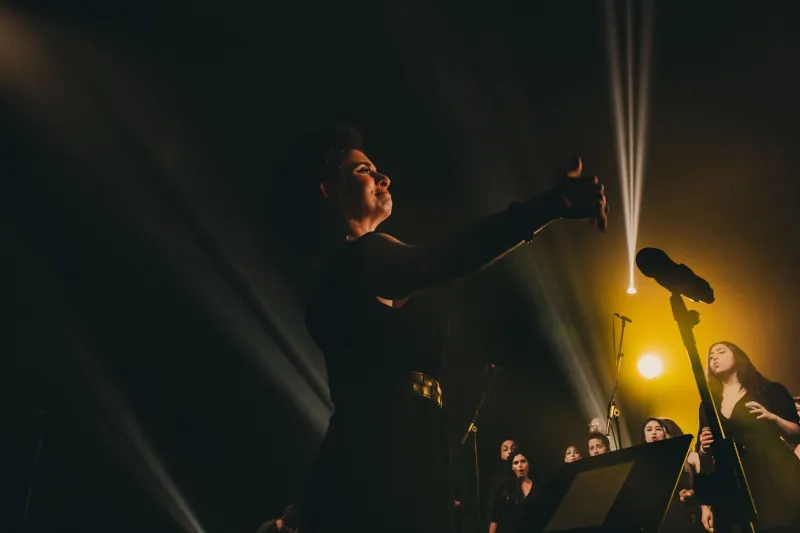
There's a question worth asking the next time you watch a major pop or rock concert — one where the lighting rigs look like a NASA project, the costumes belong in a museum, and the lead singer seems to be playing a character as much as performing a set. Who taught artists that a live show could operate on that level? Who first decided that standing behind a microphone and playing the hits wasn't nearly enough?
The honest answer, if you're willing to trace the lineage properly, keeps circling back to Deborah Harry.
The Stage as a Canvas
When Blondie hit their commercial peak in the late 1970s and early 1980s, the dominant model for a rock live show was pretty straightforward: band plays songs, crowd goes wild, everyone goes home. The spectacle, if there was any, usually came from raw energy and volume. Theater was something that happened in a different building entirely.
Deborah Harry didn't accept that boundary. From early Blondie performances at CBGB through their arena-filling tours behind Parallel Lines and Eat to the Beat, she was treating the stage like a director treats a set. Every entrance, every pause, every shift in posture was calculated to communicate something beyond the music itself. She understood — instinctively, it seems — that an audience doesn't just hear a performer. They read one.
The Eat to the Beat concert film from 1979 is one of the clearest documents of this approach. Shot as a companion piece to the album rather than a straight live recording, it positioned Harry as a figure who existed in a constructed visual world. She wasn't just singing songs; she was inhabiting them. The decision to shoot the performances as a film — with cinematographic intent, with framing choices and lighting that served a narrative — reflected a philosophy she'd been developing for years. A rock performance could have a point of view. It could be authored.
Costume as Character
One of the most underappreciated dimensions of Harry's theatrical instinct was her relationship with costume. This wasn't just about fashion, though she obviously understood fashion at a level most rock musicians never reached. It was about using clothing as a storytelling device — the way an actor uses wardrobe to signal who their character is before they've spoken a single line.
Her look shifted dramatically across different eras and even across different songs within the same performance. The platinum hair and deconstructed glamour she brought to early punk-era shows communicated something completely different from the sleek, almost futuristic presentation of the Autoamerican period. Each visual identity corresponded to a sonic and emotional world. She was essentially doing what theater has always done: using appearance to set the terms of engagement before the audience has processed a single lyric.
This is the move that Lady Gaga would later develop into an entire artistic philosophy, and it's the same instinct driving the elaborate costume narratives of Beyoncé's Renaissance tour. The lineage isn't always credited out loud, but it's hard to look at how those artists deploy visual identity as narrative structure and not see the Deborah Harry fingerprints all over it.
Blurring the Line Between Performance and Persona
What made Harry's theatrical approach particularly radical was that it never felt like a disguise. Some artists use theatrical elements to hide — to put on a mask that lets them escape into a character. Harry did something more sophisticated and, ultimately, more influential. She used theatrical framing to amplify a persona that felt genuinely, authentically hers.
There was always a quality of deliberate construction to how she presented herself onstage, but it never read as fake. The detachment, the cool, the way she could deliver a lyric about desire or danger with an expression that gave nothing away — these were theatrical techniques deployed in the service of a real artistic identity. The mask and the face were the same thing.
This is a distinction that matters enormously for the artists who followed. Performers like David Bowie and Alice Cooper were using theatrical personas to become someone else entirely. Harry was using theatrical tools to become more fully herself — or at least, a heightened, stage-ready version of herself. It's a subtler and arguably harder trick to pull off, and it's the model that most contemporary artists actually operate from. Think about how Billie Eilish uses visual and staging elements not to escape her identity but to define and project it. That's Harry's model, not Bowie's.
The Choreography of Cool
Another element of Harry's live performance genius that doesn't get enough attention is her understanding of stillness. In an era when rock performance was largely synonymous with physical abandon — jumping around, windmilling, climbing the speaker stacks — she recognized that not moving could be the most powerful choice of all.
Her stage presence often worked through deliberate restraint. A held gaze, a minimal gesture, a moment of absolute stillness in the middle of a song that was practically vibrating with energy. These were theatrical techniques, borrowed consciously or not from performance traditions where every physical choice carries weight. The result was a kind of magnetism that pure physical energy can't manufacture. You couldn't look away from her precisely because you never knew what she was going to do — or not do — next.
The Weeknd's recent live productions, particularly his After Hours era performances, operate on a similar principle. There are moments of intense stillness and controlled presence surrounded by overwhelming spectacle. The contrast is the point. Harry was working that dynamic decades earlier.
What the Stages Look Like Now
Walk through the production design of any major concert tour today and you'll find ideas that Deborah Harry was stress-testing in the late 1970s and early 1980s. The integration of visual narrative into song performance. The use of costume as character development. The understanding that an audience's emotional experience of a show is shaped as much by what they see as what they hear. The deployment of theatrical restraint as a tool for building tension and presence.
None of this emerged fully formed from nowhere. It was developed by artists willing to think about live performance as something more than a delivery mechanism for recorded songs — as an art form in its own right, with its own grammar and its own possibilities.
Deborah Harry was one of the first rock performers to think in those terms consistently and ambitiously. The stages she performed on in those years were laboratories, and the experiments she ran in them are still producing results every time a major artist steps into an arena and makes you feel like you're watching something that could only happen once.
That's not a small legacy. That's the foundation the whole thing is built on.